
Mold Testing in Palm Bay: What Homeowners in Brevard County Should Know
If you’re considering mold testing in your Palm Bay home, you’re probably dealing with one of three things: a musty odor, visible staining, or recent water damage.
In Brevard County, mold concerns are common. Between heavy summer rains, hurricane season, slab foundations, and year-round humidity, moisture is part of everyday life.
But here’s what many homeowners don’t realize:
Mold testing isn’t always the first step.
Sometimes it’s necessary. Sometimes it’s not. The key is understanding when testing provides useful information — and when moisture inspection alone is enough.
If you live in Palm Bay, Melbourne, Rockledge, Titusville, Merritt Island, or surrounding areas, here’s what you should know about mold testing.
What Mold Testing Actually Measures
Mold testing does not “find” mold in the way many people expect.
Instead, testing typically measures:
- Airborne spore levels
- The types of spores present
- Differences between indoor and outdoor air
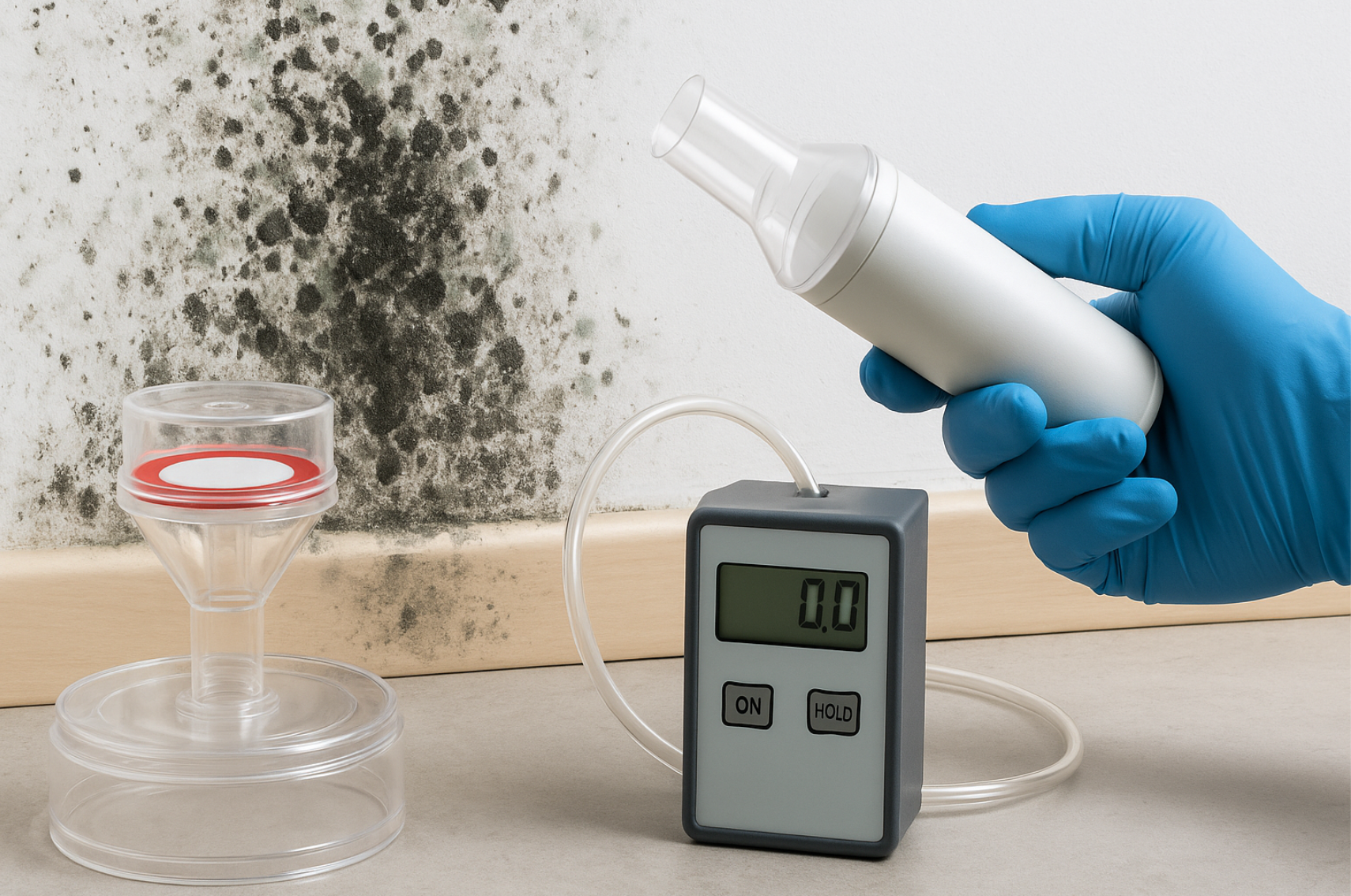
Air samples are collected using a calibrated pump that pulls air across a collection device. That sample is then analyzed by a laboratory.
The lab identifies spore types and counts.
What matters most is comparison. Indoor spore levels are evaluated against outdoor baseline levels. Since mold spores naturally exist outdoors, elevated indoor levels may indicate active growth somewhere inside the home.
Testing provides data — but it does not replace a thorough inspection.
When Mold Testing Is Helpful in Palm Bay
In Brevard County, mold testing is most helpful in specific situations.
1. There’s a Strong Odor but No Visible Mold
If your Palm Bay home smells musty but no visible growth can be found, air sampling may help confirm whether hidden mold is present.
2. After Water Damage
Following roof leaks, plumbing failures, or hurricane intrusion affecting Palm Bay or Satellite Beach, testing may help determine whether mold developed during drying.
3. Real Estate Transactions
Buyers in Rockledge or Melbourne often request mold testing for documentation purposes before closing.
4. Health Concerns
If occupants are concerned about indoor air quality, testing can provide baseline data for comparison.
Testing adds clarity when uncertainty exists.
When Testing May Not Be Necessary
If visible mold is clearly present and a moisture source is obvious, testing may not change the remediation plan.
For example:
- A roof leak causing ceiling mold
- A plumbing leak under a sink
- Attic mold due to poor ventilation
In these cases, the solution is moisture correction and proper removal.
Testing won’t eliminate mold. Moisture control will.
In Palm Bay homes, especially slab-built properties, the focus is almost always on identifying and correcting the source first.
The Importance of Moisture Inspection
Before testing, a professional inspection typically includes:
Visual Assessment
Examining ceilings, walls, baseboards, attic spaces, HVAC systems, and plumbing areas.
Moisture Mapping
Using moisture meters and infrared tools to detect hidden dampness.
Humidity Evaluation
Measuring indoor humidity levels to determine environmental imbalance.
Palm Bay homes frequently experience elevated indoor humidity due to:
- AC systems cycling improperly
- Poor attic ventilation
- Clogged condensate drain lines
- Storm-related intrusion
Without correcting moisture, testing results may not solve the issue.
Types of Mold Tests Commonly Used
In Brevard County residential settings, two main types of testing are used.
Air Sampling
Air samples measure airborne spore concentrations.
Indoor samples are compared to outdoor samples to determine if indoor levels are elevated.
Surface Sampling
Surface samples may be collected from visible growth to identify the type of mold present.
Surface testing is often used when documentation is required or when confirming whether staining is mold.
Both methods provide lab-confirmed data.
Understanding Mold Test Results
When lab results return, they typically show:
- Spore types detected
- Spore counts per cubic meter of air
- Comparison between indoor and outdoor samples
Elevated indoor levels compared to outdoors may suggest active growth.
However, interpretation matters.
For example, after heavy storms in Cocoa or Titusville, outdoor mold counts may be high. Indoor levels must be evaluated in context.
This is why experienced local interpretation is important.
Why Florida’s Climate Makes Testing Unique
Mold behaves differently in Florida than in dry states.
Palm Bay homes face:
- High year-round humidity
- Hurricane-driven rain
- Slab foundation moisture
- Constant AC usage
- Warm attic environments
Outdoor spore levels in Brevard County can fluctuate seasonally, especially after rain events.
Testing results must account for these local environmental patterns.
A result that seems elevated elsewhere may be normal for Florida’s climate — or vice versa.
HVAC and Mold Testing
In Palm Bay homes, HVAC systems often play a role in indoor air quality.
If musty odors are strongest when the AC turns on, testing may focus on:
- Air handler closets
- Evaporator coils
- Ductwork
Testing near vents can help determine whether airborne spores are circulating through the system.
However, cleaning and maintenance remain the primary solutions if moisture is present.
What Happens After Testing?
If testing indicates elevated indoor mold levels, the next step is identifying and correcting the moisture source.
That may involve:
- Roof repair
- Plumbing repair
- Drain line clearing
- Attic ventilation improvement
- Dehumidification
Once moisture is controlled, remediation may be recommended if contamination is extensive.
In some cases, follow-up testing confirms that indoor spore levels have returned to normal ranges.
Testing is part of a larger moisture management process.
Preventing Mold in Palm Bay Homes
Testing is useful, but prevention is better.
Palm Bay homeowners can reduce mold risk by:
- Keeping indoor humidity below 55%
- Servicing HVAC systems annually
- Flushing AC drain lines regularly
- Inspecting attics after storms
- Repairing leaks immediately
- Ensuring proper drainage around slab foundations
After hurricanes affecting Rockledge, Merritt Island, or Satellite Beach, checking ceilings and attic spaces within 48 hours can prevent widespread growth.
Moisture awareness is key.
Why Local Experience Matters in Brevard County
Interpreting mold testing results requires understanding local climate patterns.
Brevard Mold Inspections & Removal works throughout Palm Bay, Melbourne, Rockledge, Titusville, Merritt Island, and surrounding areas. Local experience allows for accurate testing interpretation and practical recommendations.
Florida’s humidity changes how mold behaves.
Knowing that difference matters.
A Practical Perspective on Mold Testing
Mold testing in Palm Bay isn’t about proving your home is “safe” or “unsafe.”
It’s about gathering useful information when uncertainty exists.
Sometimes testing is helpful. Sometimes moisture inspection alone is enough.
If you’re dealing with musty odors, water damage, or visible mold, the most important step is understanding where moisture is present and correcting it.
In Brevard County’s climate, moisture control remains the foundation of any mold solution.
Testing supports that process — but it never replaces it.